Blue Willow China: The Pattern That Tells a Thousand-Year-Old Love Story
Hi there, friends, today I’m so excited to share a story that’s close to my heart—one that combines history, romance, and a whole lot of charm. If you’ve ever admired the delicate blue-and-white patterns of Blue Willow china, you’re not alone. This iconic design has been a favorite of mine for years, and I can’t wait to tell you the enchanting story behind it.

This post may include affiliate links; you can read my disclosure policy here.
Where It All Began
Let’s rewind to the late 1700s in England. At the time, Chinese porcelain was all the rage. The British East India Company was importing these stunning blue-and-white pieces, and everyone wanted a piece of that exotic elegance. But here’s the thing—real Chinese porcelain was expensive and hard to come by. So, clever English potters decided to create their own versions, inspired by the beauty of the originals.
Enter Thomas Minton, the mastermind behind the Blue Willow pattern. Around 1790, he designed this now-iconic motif, and it was later popularized by Josiah Spode (yes, that Spode!). The design was a hit, blending European craftsmanship with traditional Chinese imagery. But what really made it special was the story it told—a story of love, heartbreak, and a little bit of magic.

The Legend of Blue Willow
Now, let me tell you the tale that’s woven into every plate, cup, and saucer. It’s a story that’s been passed down for generations, and it goes something like this:
Once upon a time in ancient China, there lived a wealthy Mandarin (think of him as a high-ranking official) and his beautiful daughter, Koong-se. The Mandarin had arranged for Koong-se to marry a powerful duke, who gave her a box of jewels as a betrothal gift. But here’s the twist—Koong-se was already in love with Chang, her father’s kind and humble secretary.
When the Mandarin found out about their secret romance, he was furious. He forbade them from seeing each other and even built a tall fence around his estate to keep them apart. But love has a way of finding a path, doesn’t it? Chang disguised himself as a servant and snuck into the estate to be with Koong-se. Together, they fled, taking the box of jewels with them.
Of course, the Mandarin and the duke weren’t about to let them go. They chased the lovers to a small island, where it seemed like the end of the road. But in a moment of pure magic, Koong-se and Chang transformed into two doves and flew away, forever united in spirit.
The Blue Willow pattern captures this beautiful story in its design. The pagoda represents the Mandarin’s home, the bridge is where the lovers escaped, the island is where they were caught, and the doves? Well, they’re the symbol of their eternal love. Isn’t that just the most romantic thing you’ve ever heard?

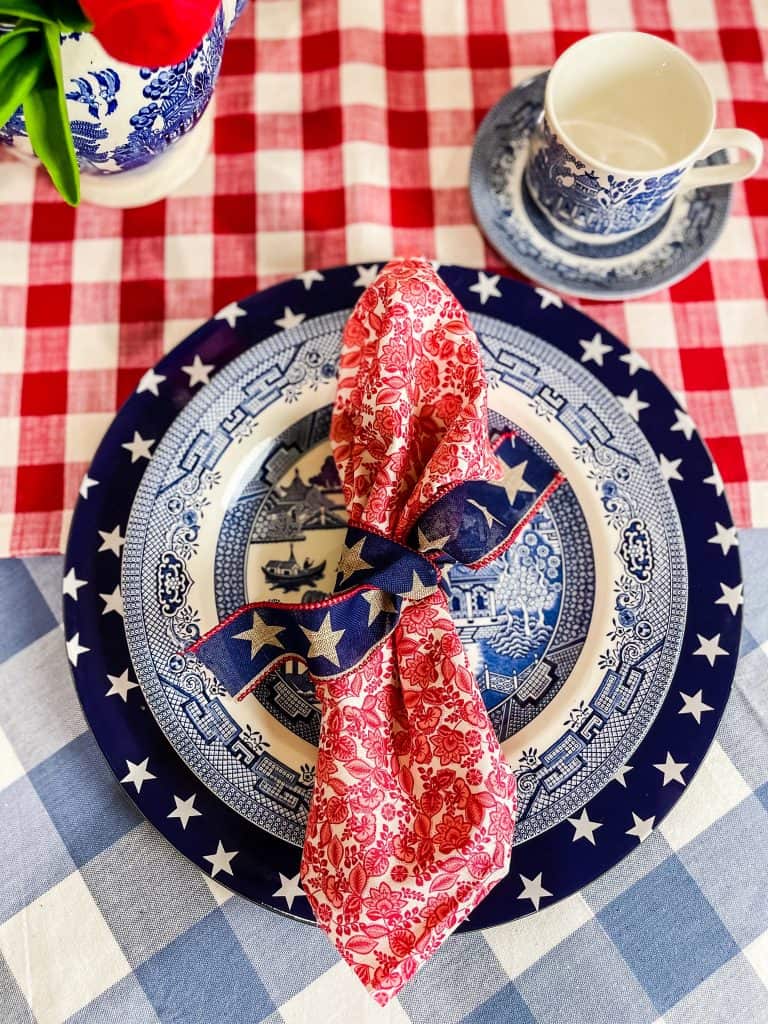
This is a very old English Blue Willow plate that I picked up while thrifting and it’s so sweet!


Why I Adore Blue Willow
I’ve always been drawn to Blue Willow china, not just because it’s pretty (though it absolutely is!), but because it feels like it has a story. Every time I use a Blue Willow plate or cup, I can’t help but think about a far away land and two kids and their incredible love story. It’s a reminder that even the simplest objects can carry so much meaning.
Plus, let’s be real—the blue-and-white color scheme is just timeless. It works with everything! Whether I’m setting a cozy table for a family dinner or creating a more formal look for a special occasion, Blue Willow always fits right in. And the best part? It’s not just for fancy china cabinets. I love mixing vintage pieces with modern tableware for a look that’s both classic and fresh.
SHOP MY STYLE

A Little Tip for Collectors
If you’re as smitten with Blue Willow as I am, you’ll be happy to know that it’s still widely available. Antique pieces from brands like Spode, Wedgwood, and Royal Worcester are treasures, but there are also plenty of affordable reproductions out there. I’ve found some of my favorite pieces at flea markets and estate sales—there’s something so thrilling about discovering a little piece of history!
Let’s Keep the Story Alive
The next time you use your Blue Willow china, I hope you’ll think about the love story behind it. It’s a beautiful reminder that even in the busiest moments of life, there’s always room for a little magic and romance.
Do you have a favorite Blue Willow piece or a special memory tied to this pattern? I’d love to hear about it! Drop me a comment below and let’s keep the conversation going!
Thanks for joining me on this little journey through history and design. Until next time, keep finding beauty in the everyday.
With love,
Amy
You Might Also Like
Blue and White Painted Pumpkins
How to Prep and Arrange Grocery Store Flowers


Amy, I love this post! I have always gravitated towards transferware and love collecting it. However, I never knew the history behind this Blue Willow pattern! Love, love, love it!! Thanks for sharing this beautiful history and china with us! 💙
Thank you Kim for sharing my post! I think people really will love the story!